
The burning of dagga fields in Eswatini is far more than an isolated law-enforcement exercise or a moral crusade against illegal drugs.
It is a deeply political act rooted in class power, state violence, and the economic architecture of an absolute monarchy that thrives on greed and the total exclusion of the majority from the economy.
For decades, black-market dagga production has been one of the few viable means of livelihood for poor rural emaSwati-particularly in the northern Hhohho region where the plant thrives like fish in the sea. However, in recent times, dagga cultivation has spread throughout all four regions of the country driven by mass poverty, unemployment, and land scarcity that has made formal economic participation almost impossible.
Yet instead of addressing the structural conditions that push citizens into informal agriculture, the state has chosen to unleash an aggressive campaign of destruction, selectively targeting the livelihoods of the poorest while allegedly protecting the interests of politically and royally connected elites.
To understand these dynamics, we must recognise dagga not as an isolated crop but as a symptom of economic exclusion. In the rural Eswatini, opportunities are scarce, entrepreneurial avenues are tightly controlled, and land tenure is dominated by traditional authority structures that severely limit the autonomy of ordinary people.
The result is an economy in which the majority survive through informal hustle: small-scale farming, cross-border trade, seasonal labour, and yes-illicit cannabis cultivation. Dagga has long served as a financial lifeline for hundreds of thousands of families, providing cash for school fees, healthcare, food security, and basic dignity in a system that otherwise leaves them abandoned. Indeed, the dagga industry has powered the rise of Swazi businesses, decent homes in the rural areas, and better lifestyles for emaSwati in an otherwise difficult and captured economic superstructure.
When the State burns these fields, it is not simply destroying plants-it is destroying the fragile economic scaffolding that keeps thousands of households afloat.
The immediate impact is economic devastation; families fall into debt, children drop out of school, and entire communities lose the only reliable source of liquidity available to them.
The government’s heavy-handed approach turns poverty into a weapon, punishes survival, and reinforces a rigid class hierarchy where wealth and opportunity flow upward while risk and suffering flow downward.
This state driven project is a class war against poor emaSwati whose political objectives are to condemn them to a life of perpetual poverty and thus subjugation and control by the monarchy.
The philosophical underpinnings that inform such a targeted assault is part of an entrenched royal outlook that believes that enriching the people erodes political control by the institutions of royalty.
Yet the story does not end with selective repression. There is a long-standing public perception, and in some cases open allegations, that individuals linked to the royal elite are monopolizing and benefiting from the illicit dagga trade industry. Indeed, it is an open secret that even the King himself and his gluttonous family are deeply ensconced in the dagga industry- together with mafias and proxies whose task is to shield them from public scrutiny. This kind of selective targeting of the poor is not unique to Eswatini; elite capture of informal markets is common in authoritarian political economies.
The pattern unfolds in predictable steps: (1) criminalise the activity, ensuring most people can only participate informally; (2) selectively enforce the law to keep the trade risky and unregulated; (3) use state power to eliminate competition; and (4) allow well-connected individuals to dominate the market under conditions of scarcity created by enforcement itself. The royal cartels that control the black market dagga industry in Eswatini dominate the entire value chain- and their dagga moves from field to buyer without any state interference. If anything, it is protected and aided by the state to move seamlessly out of the country, while dagga belonging to emaSwati is destroyed under the pretext of law enforcement.
In Eswatini, this pattern appears familiar. When dagga fields belonging to poor rural farmers are routinely destroyed by the police and the army while fields allegedly linked to powerful individuals remain untouched, it sends a clear message: the law is not a neutral instrument but a tool for managing economic competition and entrenching royal capture of the means of production and economic opportunity.
Selective enforcement drives scarcity, and scarcity drives up prices-benefiting those with the political insulation to continue production or trafficking without interference.
In such an environment, the burning of fields is not about public safety; it becomes a mechanism for consolidating economic control.
The consequences ripple through the market. When thousands of small producers are eliminated, the remaining supply is pushed into fewer hands. Prices rise, and profits concentrate upward.
The poor lose their only source of income, while the royal elites accumulate greater market share and control.
Whether through direct participation, indirect patronage, or simply benefiting from structural imbalances, politically connected actors become the primary winners in a deliberately distorted economy.
This dynamic fits into a broader pattern visible across Eswatini’s economic landscape. For decades, the royal family has extended its reach into nearly every profitable sector: telecommunications, mining, real estate, sugar, finance, timber, retail, hospitality, and even transport. Through state-owned companies, royal investment vehicles, and Crown-controlled land, the monarchy’s tentacles stretch deeply into the commanding heights of the economy.
The result is a system where the line between state, monarchy, and private capital is not merely blurred but erased. Economic opportunity becomes a closed circuit, accessible only through political proximity.
In this context, the suppression of the black dagga market is not an isolated action-it is a continuation of the same logic of economic centralization and exclusion. When the poor create their own parallel economy, however small or informal, it threatens the monopoly of power. Illicit or not, dagga farming represents economic independence in a system engineered to prevent it.
The state-led burning of dagga fields is therefore not simply about “illegality”; it is about maintaining control.
It is a reminder that no economic space exists in Eswatini that is not ultimately subordinated to royal authority. It is therefore a clash of class interests.
Moreover, the state’s approach erodes public trust. Instead of offering a path toward legalisation, taxation, and community benefit-as seen in South Africa, Lesotho, and other regions that have legalized the industry for national economic development-the Tinkhundla government chooses punitive measures that target those least able to absorb the losses.
This not only fuels resentment but deepens inequality and cements the perception that the monarchy is not merely indifferent to the suffering of ordinary people but actively engineering a system that keeps them dependent and impoverished.
The core issue here is not dagga; it is power.
Dagga is merely the latest arena where the struggle over economic sovereignty between the common people and the ruling elite is being waged.
As Simon Bright dexterously illustrates in the film, “The King and the People,” the contours of the national grievance are mirrored through economic interests which have been monopolized by the royal family. By destroying the livelihoods of the poor while allegedly shielding elite interests, the state reinforces a political and socio-economic order that privileges the few at the expense of the many.
This is not governance; it is extraction. It is not development; it is domination. It is what Adre Gunder Frank calls the development of underdevelopment.
In the end, the burning of dagga fields is symptomatic of a broader and more dangerous trajectory: a royal project to monopolise economic opportunity, suppress independent livelihoods, and maintain an economy of scarcity in which the population remains perpetually dependent and disempowered. It is a deliberate political choice – a choice that condemns the average Swazi to entrenched poverty while a tiny elite accumulates wealth behind the shield of absolute power.
The message is clear: economic life in Eswatini is not meant to be free. It is meant to be controlled. And in a system where the King and his family stand at the apex of both political and economic power, the destruction of dagga fields becomes yet another instrument for ensuring that wealth flows upward while poverty remains the permanent condition of the majority.
The struggle over dagga is therefore not only about crops and farming – it is about who gets to live with dignity and who is condemned to exclusion. It is about the future of economic justice in a country where the royal family’s greed leaves no room for the prosperity of the people.
This is why emaSwati and dagga farmers must rise to support the revolution and the establishment of a democratic government of the people that will transform the dagga industry and all other sectors of the economy to be people-centric.
The time has come to organize dagga farmers as a key constituency in aid of the liberation project. It is time!.
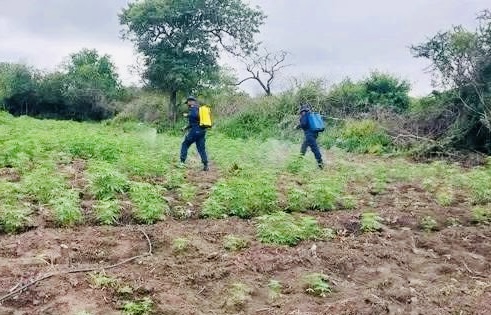
Police in Eswatini destroying dagga(pic:FB).