
When 2025 dawned, King Mswati III declared it a “year of transformation,” a year of the great turnaround in which emaSwati would finally enter the proverbial “land of milk and honey”.
The language was grand, even biblical, promising abundance after years of sacrifice and deep suffering for the people.
Yet for many emaSwati, this rhetoric felt hauntingly familiar. It echoed the tragic optimism of Mswati’s spectacularly failed Vision 2022, a grandiose project that promised prosperity, modernity, and shared national upliftment, but delivered instead deepened structural poverty, entrenched inequality, and a political economy skewed decisively in favour of the monarchy and its inner circle.
As 2025 draws to a close, the king’s declaration stands exposed not as a roadmap to transformation, but as another episode in a long tradition of royal hallucination – grand visions and wanton delusions detached from the lived realities and tragic socio-economic conditions of emaSwati.
Vision 2022 was meant to catapult Eswatini into middle-income status. Instead, it left behind a nation where unemployment remains stubbornly high, especially among the youth; where rural poverty is normalized and where basic public services continue to deteriorate.
In 2021, emaSwati rose in their thousands to challenge the gross inequalities that characterize their existence. King Mswati mercilessly massacred and silenced them – how dare they challenge him when his Vision 2022 was well on course?.
But the vision failed, not because emaSwati did not work hard enough, but because the political and economic structure of the state is fundamentally exclusionary and extractive.
Power, wealth, and opportunity flow upwards towards the monarchy and a small elite, while the majority are expected to survive on resilience, faith, and empty promises.
The 2025 “year of transformation” followed the same script: lofty words, no structural change, and worsening material conditions for ordinary people.
Nowhere is this contradiction more visible than in the much-vaunted salary review exercise for civil service workers of 2025.
Sold to the public as relief for civil servants battered by inflation and stagnant wages, the review in practice left many worse off.
Modest adjustments were swallowed by rising food prices, transport costs, and utilities.
Take-home pay did not meaningfully improve living standards. In sharp contrast, politicians across the spectrum enjoyed exponential increases in salaries, allowances, and perks – luxury vehicles, travel budgets, and benefits that insulate them entirely from the economic pain faced by the public.
Resultantly, an ordinary uneducated Member of Parliament (MP) earns over E100 000 per month – five times more than a teacher who holds a Degree qualification!.
This was not an accident or a technical oversight; it was a political choice that revealed who the state truly serves.While teachers, nurses, and clerks tighten their belts, the royal family’s wealth and largesse continue to expand with impunity.
New palaces rise, fleets of luxury cars multiply, and royal wives receive multi-million-emalangeni allowances. The monarchy’s business interests – often opaque, shielded from scrutiny, and intertwined with state resources – continue to flourish. In a country where hospitals lack medicines and schools crumble, the contrast is obscene.
The king speaks of milk and honey, yet the rivers of wealth flow only towards the palace, leaving the rest of the nation parched.
Crucially, emaSwati are consistently directed towards religion and culture as their refuge in the face of hardship.
When poverty deepens and inequality widens, the message from the throne is to pray harder, respect tradition, and accept suffering as virtue.
This philosophy is often justified through reference to the historic Somhlolo vision, which urged emaSwati to follow the Bible and to shun the corrupting influence of wealth. Yet this moral instruction becomes deeply incredulous when measured against the conduct of the monarchy itself. While the people are encouraged to find solace in scripture and cultural obedience, the monarchy has clearly chosen a different refuge: money, accumulation, and conspicuous consumption.
The royal household has not followed the Bible’s warnings against excess; it has followed capital, privilege, and material expansion.
The result is a hollow moral economy in which austerity is spiritualised for the poor, while opulence is normalised for the ruler.
The metaphor of the “land of milk and honey” is particularly cruel in this context.
In biblical tradition, it signifies liberation from oppression and entry into collective abundance. In Eswatini, it has been appropriated to mask continued domination.
For the majority, daily life in 2025 is defined by food insecurity, informal hustling, debt, and migration in search of work.
Young people see no future at home.
Women bear the brunt of unpaid care work and poverty. The informal sector absorbs desperation rather than generating dignity.
To describe this reality as transformation is not merely inaccurate; it is insulting.
What makes the king’s declaration especially hollow is the absence of accountability.
When Vision 2022 spectacularly collapsed, there was no reckoning, no admission of error, no consequences.
Instead, a new vision was declared, as though words alone can reset history.
This pattern – announce, fail, forget, reannounce – has become a defining hallmark of absolutist rule. It thrives precisely because power is unchecked.
Without democratic oversight, independent institutions, or a free political space, royal pronouncements float above reality, unencumbered by evidence or responsibility.
The increasing wealth of the royal family amid national decline is not a coincidence; it is the system working as designed.
Eswatini is not poor by accident. It is poor because its economic surplus is captured by a monarchy that treats the state as personal property while manufacturing endemic poverty. Transformation, in any meaningful sense, would require dismantling this arrangement: opening the political space, subjecting royal finances to scrutiny, redirecting public resources to social investment, and empowering citizens as rights-bearing participants in governance. None of this featured in the king’s 2025 declaration.
As the year ends, emaSwati are left once again outside the promised land, looking in from the margins.
The land of milk and honey already exists, but only for a royal minority insulated from hardship by birthright and coercive power. For everyone else, the king’s vision remains what it has always been: a mirage shimmering on the horizon, receding with every step taken towards it.
Until the structure of power itself is transformed, royal declarations will continue to be hallucinations – grand, self-serving, and tragically disconnected from the lived reality of the people they claim to inspire. The people need to decisively deal with the parasitic monarchy. There is no other way. It is time!.
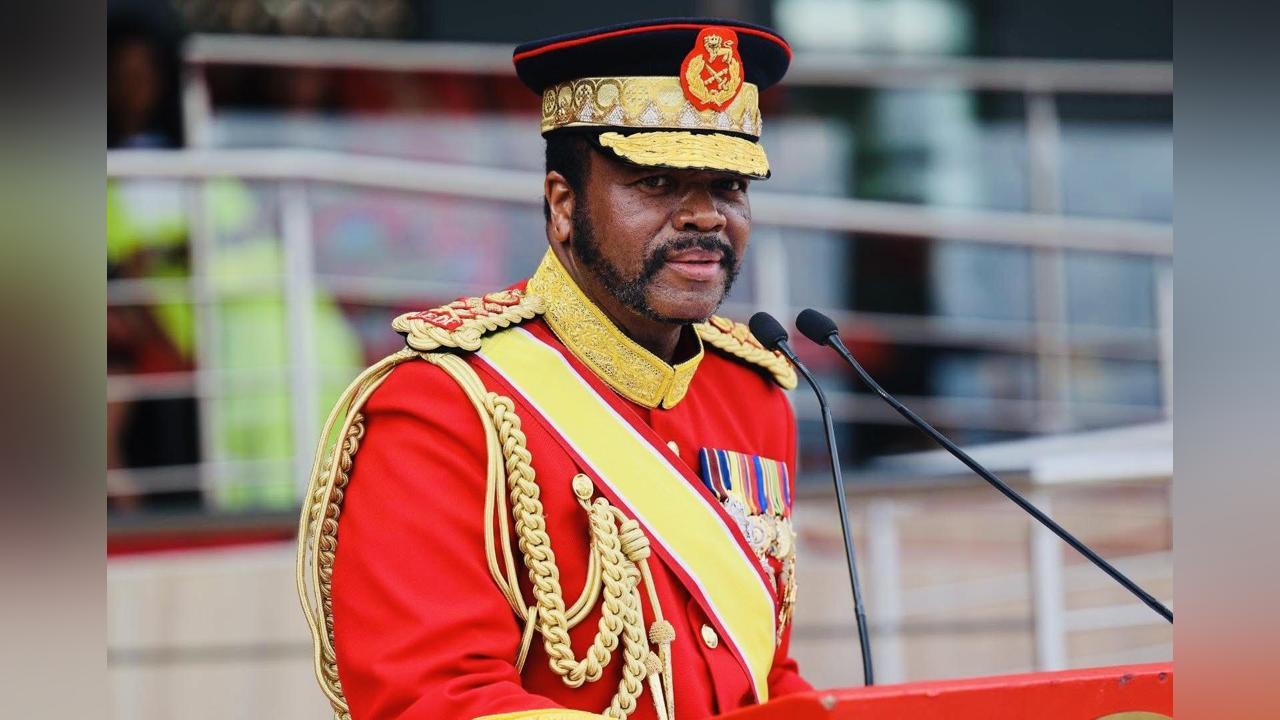
King Mswati (pic: Internet).