
The development of the Nation in almost three hundred (300) hundred years since the dawn of recorded history has never reached the crossroad and dichotomous moment like today.
This plays out mainly in the clandestine interaction of the dual legal system being Swazi law and customs against the Roman Dutch Law.
But this is courtesy of our inherently different origin, history, social engineering and development.
We have leaved under a system of unwritten rules and procedures commonly observed, recognized and respected by all over a particularly long period of time thus accepted as Swazi Law and Custom.
We then received an inherently foreign law, which was not only imposed, but was as is completely foreign to our environment and circumstances.
In fact at the beginning it was used by the whites to manage their administrative affairs and adjudicate their disputes to the preclusion of the natives who had their traditional system as led by their leader, who was reduced to a Paramount Chief after the Mbhambha Nsibandze versus King Bhunu murder saga at the end of 1800s.
The thrust of today’s brief reflection is the usage interchangeable of the word King and or Ingwenyama in not only the constitution, but almost all laws as well as policies thus the operational demeanor of any institution of the state.
This is the biggest source of legal and political dillema self created by the Monarchy for its own survival and cleavage to power.
The King is a status that was bequeathed to us from the English colonial settler state and Government.
It delineated roles and duties under the office of the King, powers and limitations of the same, as emaSwati we never had a king, but had Ingwenyama.
This being the spiritual head and supernatural being, the epitome of the embodiment of our social, economic and political organization of the Swazi nation as per the dictates of time and space in the development of the Swazi state then Government.
We marshaled our progression through all seasons and storms to survive the untollerable and treacherous journey of Nation building and development.
The advent of not only the coming of white rule, but the struggle for self rule and independence became one toughest yet testing time for us but also the monarchy or Royalty as we could call it.
This institution had grown obsolete, irrelevant and facing existential threat from within and without.
The usurpation of the independence project from the 1960, until 1973 and most importantly 2005 constitution reflects desperate measures and renewal convulsions by an institution that seeks to modernize,and reposition itself as the future and ideal embodiment of the Swazi Nation.
The time for emaSwati to openly challenge the deliberate thuggery and manipulation of the two legal systems to the detriment of ordinary citizens and confusion of state institutions is now.
It’s unfathomable that in 2025, as a country we have urban areas either directly under a chiefdom or bordered by such an institution which is not by design meant for such a human settlement.
This has been a dillema for mbabane Municipal council over Mangwaneni Umphakatsi,Matsapha council with various imiphakatsi bordering the industrial estate.
This gravely undermine development, proper human sanitation and worse promote inherent corruption in Ezulwini where a traditional structure collects revenue without any services nor accountability.
We furthermore have our lived reality that teaches us very painful, drama filled and chaos in how state power gets used through not only forum shopping, this being the picking if not choosing under which of the two best suits parties,but also the territorial turf war of Swazi Nation land versus title deed urban or crown land administration.
Thousands of emaSwati who khontaed laboring under the belief that such pieces of land belongs to one Chief, fifty years down the line, a farm owner emerges to evict them without defense nor forum for redress.
The conclusion we ought to make is that, royalty in Eswatini is more obsessed with its own survival, interests and aspirations.
It prosecutes this adventurist opeture typical of institution faced by doldrums of negation and relevance seeking organ, in a face of a completely knowledge driven developmental path more than spiritual dogma as ancient times were.
The future of this beloved country belongs to clarity of thought and precision in action. Anything less remains a threat to sustainable peace and egalitarian economics of our children and descendants to be.
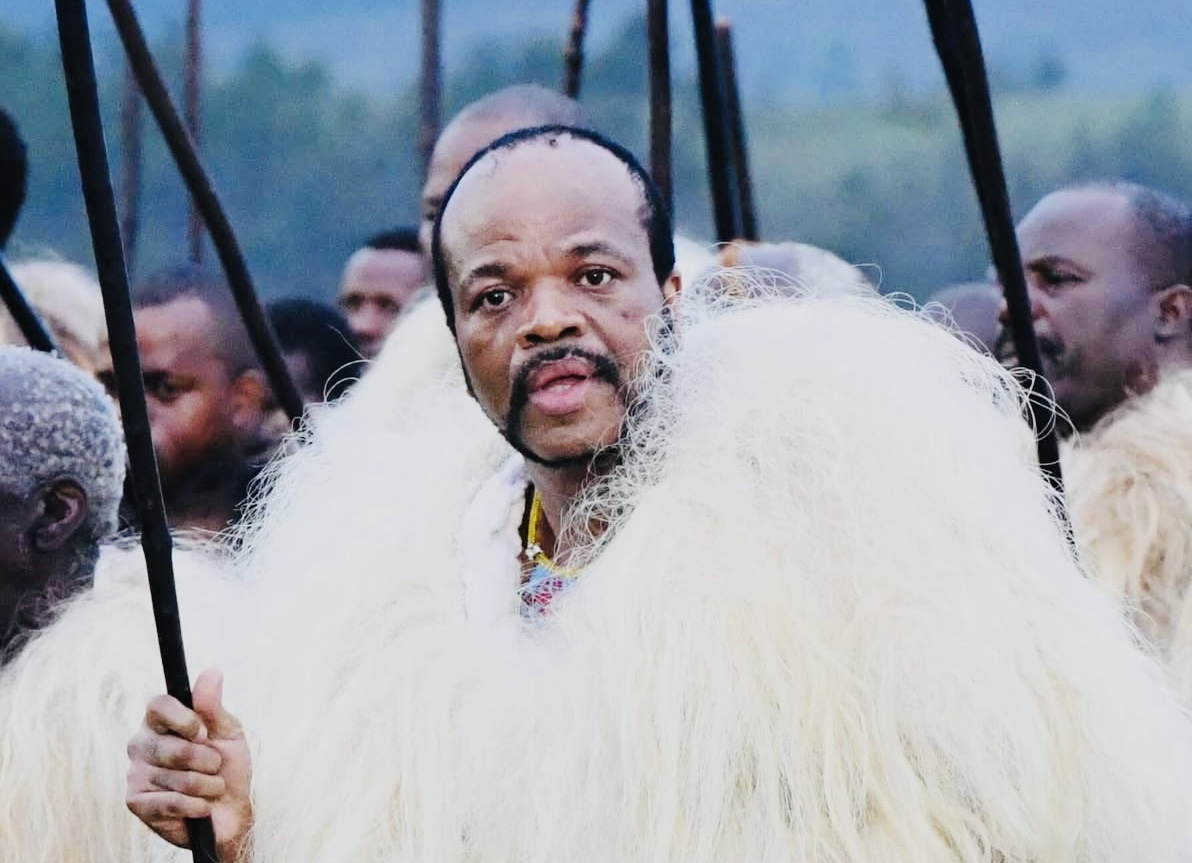
King Mswati (pic:Eswatini TV).