
Today marks exactly three years since Thulani Rudolf Maseko was assassinated at his home kaLuhleko, Bhunya.
Three (3) years since an indefatigable, brilliant legal mind, a fearless human rights defender, and a gentle but unyielding revolutionary was gunned down in cold blood inside his sitting room, in front of his wife and children.
Three years of pain, anger, and unanswered questions. Three years of deliberate silence by a regime that fears the truth more than it fears justice.
I write this not as a distant observer, but as a friend, a brother, and a comrade of Cde.
TR. I write as someone who walked alongside Thulani in thought, in struggle, and in the enduring belief in the possibilities of freedom for our Motherland.
His murder was not just an attack on one man but it was an attack on the very idea that Eswatini can be free, democratic, and governed by the rule of law. Thulani lived by his words. “Until that day when change comes to my country, I will be on the road to justice,” he once said.
That road was not metaphorical for him. It was a daily commitment – a struggle expressed through courtrooms, public lectures, writings, and relentless advocacy. He radically strove to confront tyranny using the law, and brutality with principle. He knew the cost. He had already tasted imprisonment, harassment, and exile within his own country. Yet he never retreated and on this day three years ago he paid the ultimate price.
Another of his enduring declarations, “The struggle continues,” was not a slogan of despair but an unequivocal statement of intent and discipline.
Thulani understood that liberation is not an event, but a process that is often long, painful, but always necessary. He reminded us that authoritarianism survives on fear and forgetting, and that resistance survives on memory and courage. In his writings and speeches, Thulani warned us plainly: “Dictatorships do not reform themselves. They must be confronted.” With great clarity, he counseled us that we cannot use the tools of the dictator to dismantle his house. He rejected the lie that stability can exist without freedom, or that peace can be built on injustice. He believed deeply that constitutional democracy was not a foreign imposition, but the rightful inheritance of the people of Eswatini. He often said, “Power belongs to the people, not to a family.” For that truth, he was marked and killed.
On the very day Thulani was murdered, King Mswati III issued chilling threats against pro-democracy leaders, boasting of mercenary forces and vowing to crush dissent. Those words were not abstract. They were followed by bullets. Thulani was executed hours later. The timing was not coincidental. It was a message written in blood: challenge the monarchy, and you will pay with your life.
Three years on, there has been no credible investigation. No arrests. No prosecutions. Instead, there has been obfuscation, intimidation, and a calculated attempt to erase this crime from the nation’s collective memory.
The regime wants us to move on, to forget, to normalize the killing of a human rights lawyer as collateral damage. We refuse. We shall never forget – ever!.
The chair of the Multi-Stakeholder Forum, which Thulani occupied with rare moral authority, has never been the same since he was killed.
That chair is no longer a mere administrative seat. It is a chair dripping with his blood. Those who have since occupied it do so in the long shadow of his sacrifice. It is a position that carries a sacred duty to pursue justice without fear or favour, to honour the man who paid with his life for truth, and to ensure that his assassination does not become just another unresolved statistic. To sit in that chair without demanding accountability is to betray its meaning.
It must instead become a platform from which justice is relentlessly pursued and the struggle intensified. It must be the radical anchor for a people determined to march relentlessly forward to freedom and justice.
The King and his government stand condemned not only by what they did, but by what they have failed to do. Their silence is an admission. Their obstruction is complicity. Justice delayed is justice denied and in this case, justice deliberately buried.
That is why I join countless others in calling for the United Nations to institute an independent international investigation into the assassination of Cde. TR. Eswatini’s institutions have proven impotent, incapable and unwilling to deliver justice where the monarchy is implicated.
International law exists precisely for moments like this, when a state becomes both suspect and obstructor of justice.
Thulani, drawing from the wisdom of Victor Hugo once wrote, “You can imprison a person, but you cannot imprison an idea whose time has come.” His killers understood the danger of his ideas. They believed that by silencing his voice, they could stop the momentum for democracy.
They were wrong. His ideas live on in court filings, in protest chants, in whispered conversations, and in the quiet resolve of a people who have lost their fear. To Thulani: my brother, my comrade, my friend.
We remember your laughter, your sharp intellect, and your stubborn hope. We remember your courage, even when it cost you everything. We remember that you chose justice over safety, truth over comfort, and country over self. We shall never forget.
We shall fight until justice is attained for you, for your family, and for the country and its people whom you so dearly loved. You remain the moral compass of this revolution.
The struggle continues brother – not as ritual, but as responsibility. The pro-democracy forces must heighten the struggle, deepen strategic actions, and sharpen resistance until this country is freed from royal rule. Until justice is done and until the Motherland is free. The struggle never sleeps. It is time.
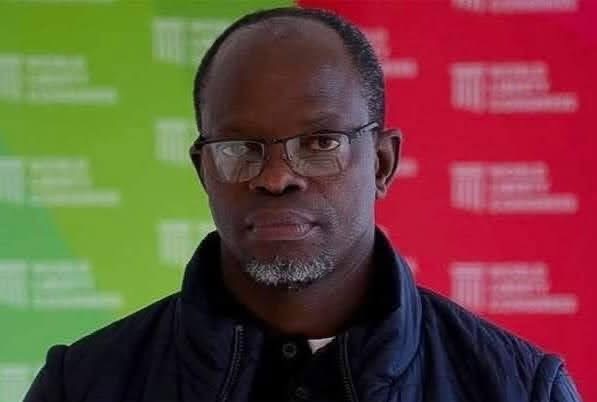
The late human rights lawyer Thulani Maseko.