
MBABANE:The Human Rights Measurement Initiative (HRMI) has released its 2025 data on eSwatini, painting a sobering picture of the country’s human rights landscape, the international human rights organization said through a press statement sent to this Swaziland News.
Drawing on insights from human rights experts, lawyers, civil society actors, journalists, and practitioners, the report provides robust, evidence-based scores on both civil and political rights and economic and social rights.
HRMI’s findings on civil and political rights show that eSwatini scores just 4.9 out of 10 on Safety from the State and 2.9 out of 10 on Empowerment Rights, reflecting widespread restrictions on free speech, assembly and association, and participation in governance. Arbitrary arrests and torture and ill-treatment remain significant threats, especially for activists, journalists, and political critics. Although eSwatini maintains its abolitionist stance on the death penalty and offers strong protection for religious freedom, these positives are overshadowed by systemic violations of fundamental freedoms.
On economic and social rights, Eswatini achieves 67% of its income-adjusted benchmark which falls under HRMI’s ‘very bad’ performance range. According to HRMI’s data, the government of eSwatini’s performance falls under the ‘very bad’ or ‘bad’ range across all the rights assessed: education (84.4%), food (75.5%), and health (77.7%) fall within the ‘bad’ range, while housing (55.9%) and work (41.7%) sit in the ‘very bad’ range, indicating acute shortfalls in shelter and secure livelihoods.
According to human rights experts on the ground, vulnerable groups, including women, children, people with disabilities, migrants, LGBTQIA+ communities, and human rights defenders face heightened and intersecting risks across both economic andsocial and civil-political dimensions.
Nkosi Sibanda, East and Southern Africa Lead at HRMI, stated, ‘This year’s data confirm what many in eSwatini have long experienced: systemic repression of civic freedoms alongside deep socio-economic inequalities. By grounding these realities in rigorous, transparent measurement, HRMI equips citizens, civil society, and international partners with the evidence needed to push for urgent reforms. Protecting fundamental rights is not optional, it is the foundation of a democratic and just society.’
HRMI’s eSwatini Country Lead, Velaphi Mamba, added,
“The Human Rights Measurement Initiative’s report on eSwatini is an invaluable contribution to the global community on the state of civil and political rights in the country.It shines a spotlight on the worsening human rights climate for human rights defenders across the spectrum, demonstrating the increasingly repressive character of the state. It further offers an opportunity for increased global focus, advocacy, and action to get the country democratised urgently. The report provides empirical data for all role players to converge on resolving the long-standing political crisis in eSwatini.”
HRMI will host a virtual workshop on 27 August 2025 to launch the eSwatini Report officially.
The event will bring together local and international stakeholders to explore the findings in depth and discuss strategies for advancing human rights in the country.
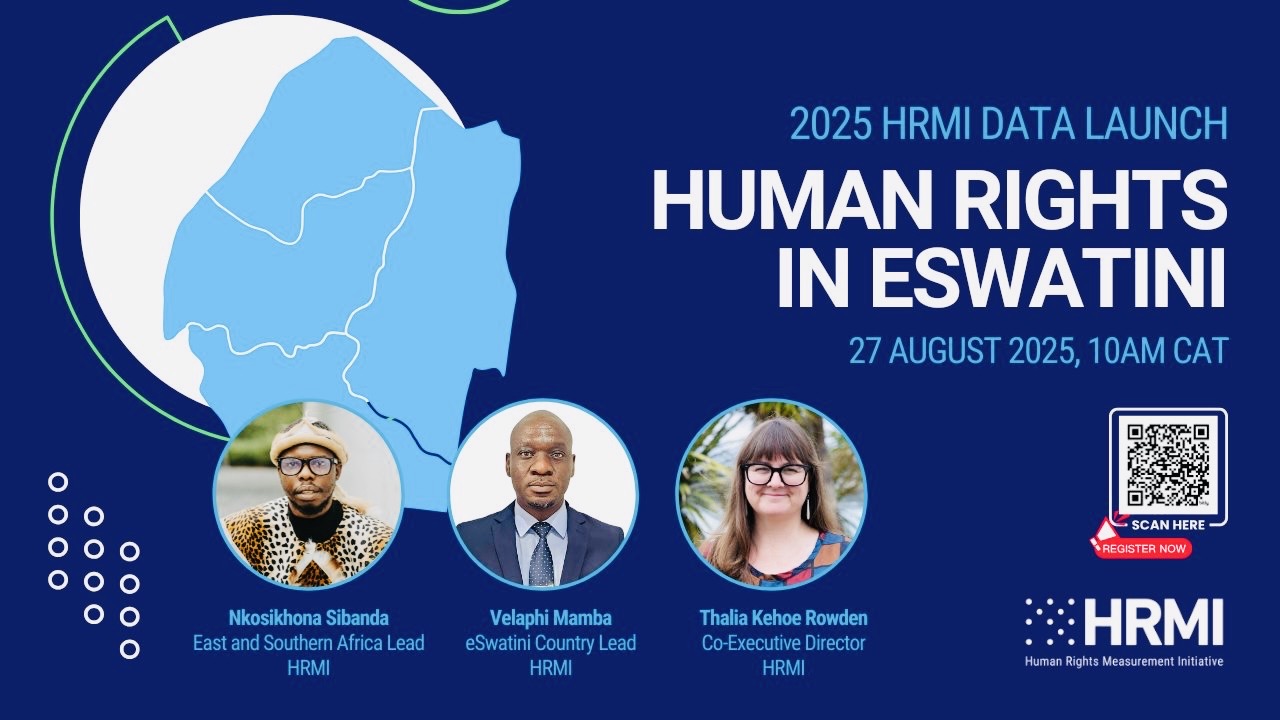
Human Rights Measurement Eswatini Country leader Velaphi Mamba says new report confirms urgent need to democratize Kingdom.